A rug can fit a hallway perfectly and still cause trouble when the door opens. Add a pad underneath, and the extra height may be enough to make the door brush the pile, catch an edge, or push the rug out of place.
The measurement that matters is the combined height of the rug and pad compared with the space beneath the door. Check that combination before choosing a thickness, particularly at entryways, bedroom doors, and narrow passages.
Measure the whole door swing
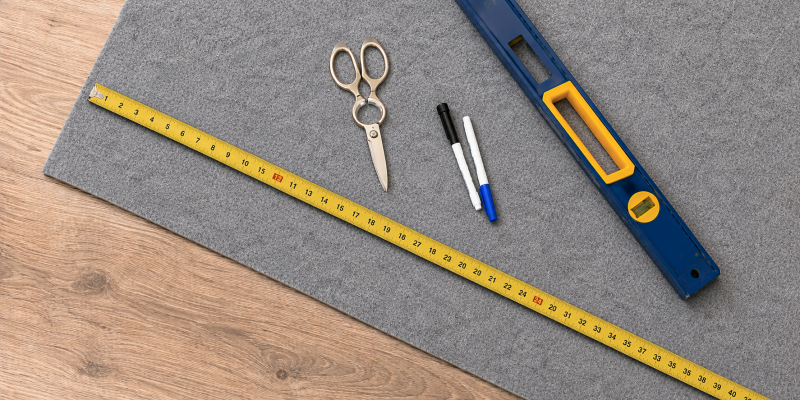
Start with the rug and pad removed from the area. Open the door slowly through the full arc that would pass over the rug, measuring from the finished floor to the bottom of the door at several points.
Use the smallest clearance you find. Floors are not always level, and the gap can change as a door travels across the room. A measurement taken only while the door is closed may miss the tightest spot.
A ruler works when there is room to see it clearly. For a small gap, a stack of cards can help you estimate the space: build the stack beside the stationary door, remove it, and measure its height. Keep hands clear of the door’s path while checking.
Note any sweep or seal beneath the door. Its operation also needs to be considered; do not assume that lifting or removing it is an appropriate way to accommodate a rug.
Add the rug and pad together
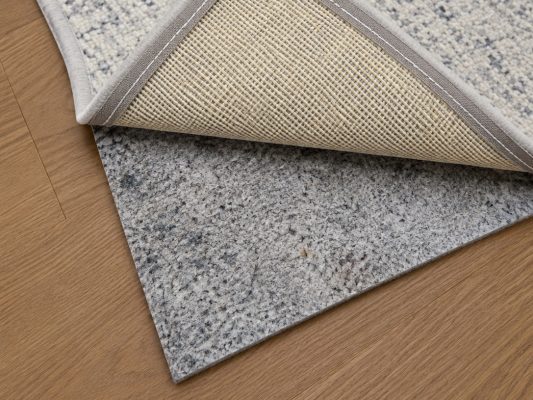
Measure the rug’s height without pressing it flat, including its backing and raised texture. Then add the proposed pad thickness. Check bound or serged edges as well as the rug’s main field, because an edge may be the first part the door encounters.
Here is a simple illustration using hypothetical measurements:
| Measurement |
Example |
| Smallest gap beneath the door |
1/2 inch |
| Rug height |
1/4 inch |
| Proposed pad thickness |
1/4 inch |
| Combined rug and pad height |
1/2 inch |
| Space remaining |
None |
That combination leaves no allowance for texture, movement, or measurement error. Choosing a thinner pad might help, but the assembled rug and pad still need to be checked in place.
Do not count on the door to compress the rug every time it opens. A combination that only fits when it is pushed down is likely to drag during normal use.
Choose by the space available
Once you know the clearance, consider what you need the pad to do.
In a tight doorway, a low-profile pad may be the practical choice when grip is the main concern. If even a thin compatible pad leaves inadequate room, moving the rug or choosing a lower-profile rug may be necessary.
In a hallway, check every door that crosses the runner, including closet doors. Also check the runner’s ends and edges along the walking route. A pad should support the runner without creating a pronounced ridge.
In a living room or bedroom away from doors, there may be more room for cushion. Furniture stability and the transition at the rug edge still matter, even when door clearance is generous.
For a broader explanation of cushion, profile, and room use, see the rug pad thickness guide at Dalton Rug Pad, our sister store. Use it alongside your measurements and the current specifications for the pad you are considering.
A thinner pad can still provide grip
Thickness and resistance to sliding are separate characteristics. A suitable thin grip pad can help hold a rug in place without adding much cushion. A thicker felt pad may add comfort while still requiring an appropriate backing to resist movement on a hard floor.
Choose the material for the floor as well as the rug. Check the flooring manufacturer’s requirements rather than assuming every rubber, felt, or foam pad is suitable for every surface.
If you need help comparing constructions, our guide to choosing the right rug pad explains the main selection factors.
Cut the pad inside the rug’s edges
The pad should generally stop approximately one inch inside the rug on each side. This keeps it out of sight and allows the rug’s perimeter to settle toward the floor.
For a runner measuring exactly 30 inches wide by 10 feet long, that would mean a pad approximately 28 inches wide by 9 feet 10 inches long. Measure the actual runner before ordering or cutting.
A proper inset does not compensate for too much height beneath the rest of the rug. The door must clear the entire portion it crosses, not just the tapered edge.
Test before putting the room back together
Lay the pad flat and center the rug over it. Open the door slowly through its full swing without forcing it. Watch for brushing, bunching, or an edge being pushed ahead of the door.
Walk the route from both directions, then check any nearby furniture. If the door drags or the rug shifts, adjust the combination before treating the job as finished. Avoid trimming a door as the first response; changes to exterior doors, fire-rated doors, or other specialized assemblies require appropriate professional guidance.
When ordering a custom-sized rug from Carpets in Dalton, consider the backing, edge finish, and intended pad together. Taking those measurements before ordering is easier than finding a clearance problem after the rug arrives.
Common questions
How much space should remain above the rug and pad?
There is no single allowance that fits every door and rug. Leave enough room for the door to move freely through its full swing without brushing the assembled rug and pad. Allow for irregular floors, raised texture, and small movements in use.
Can I skip the pad if the door is too low?
Check the rug manufacturer’s guidance and whether the rug stays secure without one. A thinner compatible pad, a different rug position, or a lower-profile rug may solve the problem more effectively.
Does a pad’s advertised thickness tell me whether it will fit?
It helps, but it is only part of the measurement. Include the rug, backing, edge finish, and the smallest gap beneath the moving door. A sample or an in-place check is more useful than pad thickness alone.