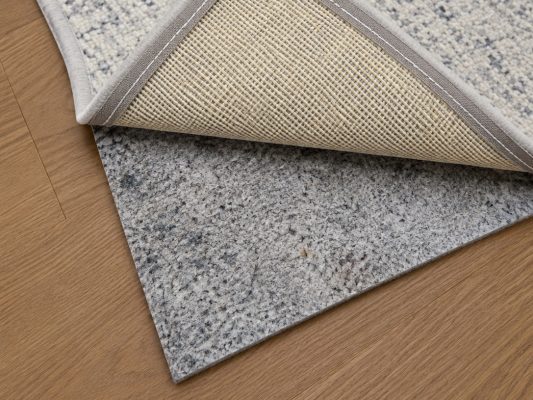
A thin rug can look exactly right in a room and still feel disappointing when you walk across it. Flatweaves and low-pile rugs often let you feel much of the hard floor underneath, especially when you’re standing barefoot beside the bed or sitting on the living room floor.
The right rug pad can make that rug more comfortable. It adds a cushioning layer beneath the rug, but the result depends on the pad’s density and construction as well as its thickness. A thin rubber grip pad and a dense cushioned pad solve different problems.
Before replacing a rug you like, it is worth looking at what is underneath it.
What a pad can change—and what it cannot
A cushioned pad creates some separation between the rug and the floor. Under a thin rug, that can make each step feel less abrupt and give the surface a more substantial feel.
It will not turn a flatwoven rug into deep-pile carpet. The surface texture stays the same, and a coarse fiber will still feel coarse against bare feet. A pad also cannot repair damaged backing, worn fibers, or a rug that is permanently distorted.
Think about the source of the discomfort. If you like the rug’s texture but dislike how hard it feels against the floor, a cushioned pad is a reasonable place to start. If the fibers themselves bother you, changing the pad may have limited benefit.
Thickness matters, but density matters too
Two pads of similar thickness can feel quite different. A soft pad may compress readily underfoot, while a denser pad may provide firmer support with less movement.
Neither feel is automatically better. You might prefer more give beside a bed, but want a firmer foundation under a living room rug that supports chairs and a coffee table. Ask about the pad’s construction and intended use instead of choosing by thickness alone.
The rug matters, too. A flexible flatweave can reveal a pad’s edges or surface texture more readily than a heavier rug. The goal is a smooth, supported rug with a comfortable feel, rather than the greatest possible amount of padding.
Choose cushion and grip separately
If your rug both feels hard and slides around, the pad needs to address both problems.
| Pad type |
What it contributes |
What to consider |
| Felt-only |
Cushion and separation from the floor |
Does not provide the same non-slip function as a suitable grip backing |
| Thin rubber grip pad |
Helps hold the rug in place with little added height |
Usually contributes less cushion |
| Cushioned pad with a grip backing |
Combines support underfoot with resistance to movement |
Check floor compatibility, firmness, and overall height |
A thicker pad does not automatically grip better. Look for a construction suited to the rug, the floor, and the way the room is used. Follow the flooring manufacturer’s guidance on compatible materials, especially over vinyl flooring or a recently finished wood floor.
Where extra cushioning makes sense
A bedroom rug is a straightforward example: you may spend little time walking on it in shoes, but notice its feel every morning. Added cushion can also be useful under a living room rug where people sit on the floor or spend time barefoot.
Doorways and busy passages require a different balance. A comfortable pad is a poor fit if it makes a door drag or raises the rug edge enough to catch your foot. Dining areas also deserve a practical check: pull the chairs in and out and make sure the rug and pad stay settled.
For a room with adequate clearance, the Extra-Thick All-Surface Rug Pad from Dalton Rug Pad is one option to consider. Our sister store describes it as a firm, dense cushioned pad with a non-skid backing. Review its current specifications and floor requirements to decide whether that construction suits your rug.
Get the fit right
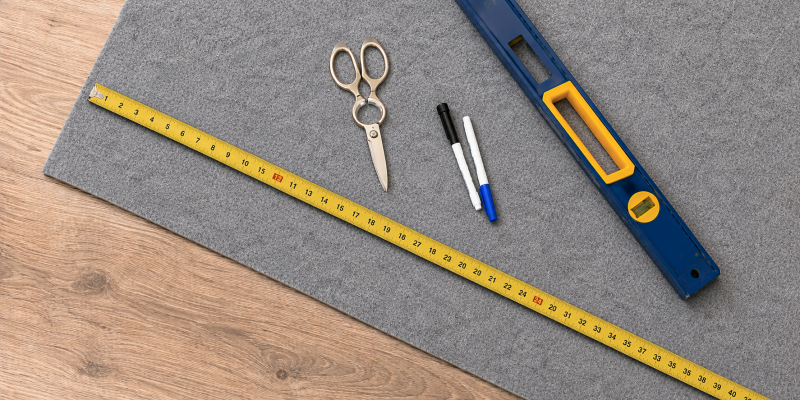
Measure the actual rug, even if you know its advertised size. Leave the pad approximately one inch inside each edge so it stays hidden and the rug’s perimeter can settle toward the floor.
For example, if a rectangular rug measures exactly 8 feet by 10 feet, a one-inch inset on all four sides produces a pad measuring approximately 7 feet 10 inches by 9 feet 10 inches. That means subtracting two inches from the rug’s total width and two inches from its total length.
Keep the cut smooth. An uneven pad edge or folded corner can show through a thin rug and spoil the improvement you were trying to make.
Try the combination where it will actually be used
If a sample is available, place it beneath the rug on the intended floor. Stand on it barefoot, press it with your hand, and check how readily it compresses. A small sample will not reproduce the stability of a full-size pad, but it can help you judge the feel.
Then check the practical details: door swing, furniture movement, the rug’s edge, and whether the backing is approved for your floor. Avoid stacking loose pads to create extra height; choose a single pad intended for the application.
If you’re choosing a new rug as well, our custom-sized rugs let you start with the material, pattern, and dimensions that suit the room. Choose the pad alongside the rug so comfort and clearance are part of the same decision.
Common questions
Will a thick pad make a flatweave feel like a plush rug?
It can add cushioning underneath, but it will not change the flatweave’s surface or pile. Expect a more supported feel rather than a different type of rug.
Can I use a cushioned pad under a small rug?
Possibly, but small, lightweight rugs need particular attention to grip and edge height. Choose a pad intended for the rug and floor combination, and check that the rug lies flat.
Should I buy the thickest pad available?
Choose the thickness that improves comfort while allowing doors, furniture, and rug edges to work properly. More height is only useful when it fits the room.